Monday, June 7, 2010

Thursday, June 3 - Vindolanda, Hadrian's Wall, and Housesteads Fort

We began the day with an independent visit to Vindolanda, an archaeological dig site located near Hadrian’s Wall. It’s interesting in that they are doing work out there everyday under the supervision of trained archaeologist. Pretty much everyone else working are volunteers, which kind of showed. Some were looking less than enthusiastic at the hard work. Another interesting feature was their interpretation panels, which included Latin (probably because the site is Roman). There wasn’t much interpretation though, and what was original and what was reproduction/replica wasn’t always clear. The little museum with some of their finds was fantastic, and extremely well preserved due to the anaerobic nature of their soil. We couldn’t take pictures inside, but here are some of the dig.


Vindolanda


Volunteers digging


Example of interpretation panel with English, Latin, and French languages


*****


After Vindolanda we drove to a public footpath leading up to Hadrian’s Wall. We then proceeded to hike about two miles of Hadrian’s Wall with Eric of National Trust (which owns this stretch of the Wall), and Mike Collins of English Heritage. NT has placed some of the management of the Wall and the forts along this particular stretch into EH’s hands. The Wall is, of course, a scheduled monument. It was interesting walking and talking with them, as we were able to see the differences in their goals and priorities, and the kind of balancing act needed between conservation and allowing the public to enjoy the site. Eric was the first representative from the National Trust that we have spoken with, but next Tuesday we will be speaking with someone at their Regional Headquarters in York. Here are some photos of the Wall.


Cows eyeing us on the public footpath


Walking part of the new Hadrian's Wall footpath


That ridge is part of the Wall


Sarah and Eric of NT with the Wall behind them


*****


We finished the day at Housesteads Fort, owned by NT and managed by EH. Here are some of us eating ice cream after a long hike.

Haley, Anjuli, Eric, Mike, Allison, Virginia and Lynn at Housesteads


Wednesday, June 2 - The Bowes Museum

John and Josephine Bowes built the Bowes Museum to allow the pubic to view their wide-ranging collection. Although at first glance it appears to be a French Chateau with a Mansard roof, it was never built to house anything other than the collection it currently holds. The couple collected over 40,000 objects, many with the public in mind. Therefore, many different periods and types of objects are represented, and each example is not always the best of its type. We met with several of the different curators, or “keepers” as they are called. Here is a brief description of what they talked about.

Picture Stores

We started high up in the museum, on the first floor located inside the dome (there are four, added during the major renovation that took place last year). This is where the main Picture Store is, a marvel in design that currently holds 1,200 paintings and 10,000 works on paper. One floor up from the main Picture Store is a secondary storage option, meant for the works on paper and paintings small enough to be placed on the lift. Here we met with Emma, the Keeper of Fine Art. We talked about their current projects, which include reuniting paintings with their original frames, making new tags that allow paintings to be identified with more ease, and imputing information about a painting into a searchable database. In the future they hope to include the stores in their public tours, but for now they are open to researchers and the curatorial staff.


Archeological Objects

We headed to the gatehouse to speak with Community Curator Samantha Belcher, who is currently funded through a grant from the MLA (Museums Libraries and Archives Council). There is no place to display the archaeology in the museum at the moment, so it is all housed in the gatehouse. Samantha and her intern, along with the help of volunteers, are currently trying to inventory the collection. The provenance of many of the objects is unknown, as Josephine may have bought many of these items in lots in France, with their original location lost along the way. Her other main purpose is to work with the community, even bringing objects out to various events for the public to view (and occasionally handle).

Library and Archives

The library is located up at the very top of the dome (the highest point in the museum and one of the spaces renovated last year). The views are spectacular. Most of the books are from John and Josephine’s original collection, although they continue to add new books through donation and purchase. The Archives were one floor down, in a strong room, along with books printed before 1900, books purchased originally as objects, and the Bowes’s French library collection. Their Archives is divided into two main categories: Records from the Bowes, mostly during their time in France and including many of the bills of sale for the objects in the museum, and the records for the Bowes Museum itself. Unfortunately we were unable to see them, although quite a few of the finding aids were out on the shelves for review. (Access to the archives isn’t exactly restricted, we just didn’t have time.) Their goals for the future include taking their archives and catalog of books online.


Textiles

We also met with Joann, the Keeper of Textiles, who was recently in charge of designing and executing one of their newest exhibits involving their textile collection. The design of the exhibit was very forward thinking, as were their storage choices. One area of the exhibit room is a glass cube, with hundreds of shelves and a workspace inside. Eventually they will keep most of their textiles stored in this room, with easy access for both museum staff and for guided tours.

We ended the day by taking tea with Jane, the Principal Keeper, which means that she is in charge of the rest of the curatorial team.

The Bowes Museum, simply put, has a lot of stuff. With the exception of a few objects, including famous works by El Greco and Goya, and the Silver Swan, there is little here that you cannot see in other historic homes and museums. The majority of the items predate 1900 and concentrate on fine and decorate arts from Europe, and the current collection policy continues to reflect this date as a stopping point. There was quite a bit of interpretation panels and sheets, and at times this was completely overwhelming. The downstairs exhibition room, meant as an introduction to the museum, is quite disjointed; for example, a whole room is donated to children’s toys, although how this relates to the museums original or current mission is unclear. I am unsure what sets this museum above or apart from other historic homes turned museums, or other museums focusing only on art or furniture. I guess it is a question of quantity over quality, and while all of the objects are beautiful, very few truly stand out.

Sunday, June 6, 2010

June 1 - Fifth Day of Projects

We found out today that this is our last chance to have access to Kiplin Hall’s curatorial room. Ack! We have so much work to do! %#$%!!!!! We stayed late to try and tie up loose ends, and we ended up bringing a lot of supplies back to Crewe Cottage. We will work a couple of hours each night until Friday, and try to wrap everything up. The workroom was also a mess today because there was a mice invasion over the weekend, and everything had to be pulled out to try and kill them all.

*Commence Rant*

Unfortunately we have to retype the whole finding aid, as no one can locate an electronic copy of it.

%$#&%$#&!!!

So tired of pulling rusty staples!!!!

Don’t staple potential archival material!!!!

Especially 5 times on one piece of paper!!!!

Metal and paper do not mix well!!!!!

Allison took pictures of us and I wasn’t wearing any makeup!!!!

*Done*

Monday, May 31 - Lake District

We are spending a lot of time in the car. But it is worth it. The Lake District, made famous by the likes of Woodsworth and Beatrix Potter, was stunning, and the car ferry we took across Windermere (Lake) was awesome! It was only about ten minutes, but still awesome!

Eating brownies, waiting for the ferry. The wait was longer than the ride!
Photo courtesy of Sarah Swinney


Haley, Anjuli, Rebecca, and our Audi on the ferry.
Photo courtesy of Sarah Sweeney


Our first visit was John Ruskin’s house Brantwood, a famous naturalist, writer, and one of the predecessors to William Morris, who made the Arts and Crafts movement famous.

Predictably, no interior shots. These places never give us good reasons for not taking photos (Security and Conservation? What does that mean??). The rooms had lots of great room sheets and a lot of signage, so there was a lot to look at. I think besides the views, my favorite part was the rotating exhibition, about the painter Edward Wilson, who was the painter on Scott’s two Antarctic expeditions (they died together on the second one). His watercolors were absolutely beautiful, very poignant. A little bit about the exhibition can be found here.

I took a solo hike up behind the house to get a few of some of the gardens designed by Ruskin. Unfortunately, I hit a solid wall of bugs, and ended up sprinting much higher than intended. I mean, I ended up really high behind the house, kind of wondering what I was doing up there, and also wishing everyone back home could see me trekking around in my boots and skirt. I wound my way across the back slope and ended up in a couple of different gardens.

These are the stairs I headed up...and up...and up...


Beautiful views of the lake


The purgatory garden was especially interesting. A kind of concept garden.


This is the sin Pride...


And these are "carpets of molten fleece", meant to represent Lust...??


Close up. I think this is actual fleece.


*****


We next visited the town of Ksswick, home to the Keswick Museum and Art Gallery, which is home to…..

Photo courtesy of Sarah Swinney


THIS!

Dead cat. Approximately 668 years old, found in the roof of a local church...


This place was out of control. They had tons of taxidermy…

Some which you could even pet…


Petting the fox...


*****

Our last stop was Castlerigg Stone Circle, a more or less unpoliced English Heritage site consisting of a prehistoric stone circle. People were climbing all over them, it was in the middle of a sheep field, and at one point some Japanese tourists grew tired of photographing the stones and eventually CORNERED one of the lambs, and it was kind of horrific. The poor thing kept trying to run past them to its herd, baaing the whole time.

Castlerigg stone circle with sheep in the background


People everywhere


So we saw quite a range of museums today. It is interesting how some English Heritage sites are administered. There was a man standing by the gate, but he did nothing to stop the tourists from climbing on the stones. I wonder what their policy on interaction with the monuments is. I will have to ask the man we are meeting at Hadrian’s Wall on Thursday.

Friday, June 4, 2010

Sunday, May 30 - Playing Catch-up

I stayed at home today to try and catch up on schoolwork. I spent the majority of my day curled up on the couch, pulling staples, and watching a 5 billion hour music video countdown. I also did some house chores, uploaded my first post for our school’s blog, and updated my own as well. The internet is working better, although it is nowhere close to what we are used to.

It was strange being home all alone today, especially every time I saw random strangers’ heads go walking by the downstairs window (Kiplin Hall was open today). But I had the washer and dryer all to myself!!!!! So all in all, a very productive day.

Saturday, May 29, 2010

Saturday, May 29 - Castle Howard

The only thing I know about the Howard family I learned from Phillipa Gregory (The Other Boleyn Girl) and The Tudors on Showtime. And although I knew little about the family or Castle Howard itself at the beginning of the day, I was sure I would learn as I moved around the museum.

Castle Howard is beautiful, of course. And we could actually take pictures inside! (Of course, how many pictures did I take? not many. I'm horrible at taking pictures, especially when I'm busy talking.)

Castle Howard. Jeez, I can't seem to take straight pictures of facades either.


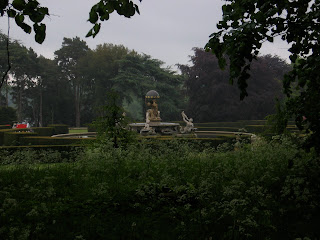
Famous Atlas Fountain. I realize you can barely see it. I think this was my attempt at "artistry" in the rain.


One of my favorite things in the house, this handmade quilt. Beautiful.


Another shot of the quilt. Sorry it is sideways. The table this quilt is on also has a bunch of family pictures of the current Howards. I am pretty sure the House Guide thought I was taking photographs of the photographs.


And here are some of the Rose Garden. Because it was raining pretty steadily, I didn’t make it to all of the gardens around the estate.


Rose Garden entrance


Some kind of folly at the end of the rose garden. Coy pond in the foreground.


Castle Howard relies on House guides, normally between 12 and 14 guides working simultaneously. They were the main source of interpretation; there were very few displays, with the exception of the rooms destroyed by fire and the exhibition room about the 7th Earl. Incidentally, that exhibition room really makes you like him. He was very against slavery and often hosted American abolitionists like Harriet Beecher Stowe when they journeyed to England on fundraising trips. He actually wrote the introduction for Uncle Tom’s Cabin.

It was hard having to rely solely on guides for interpretation, even if they are very knowledgeable. As I knew little about the history of the house, I had to wait my turn to speak to the guide in whatever room I was in, and then ply him with as many questions as I could think of. Over time I began to have a better sense of who the family was and when the house was built (a few generations after the Howards of Henry VIII’s court).

Actually, one of the best things about Castle Howard was their Farm Shop, full of fresh cheese of all kinds, awesome chocolate everything, and great breads. I had chocolate caramel shortbread. Very tasty.

One other thing: you may recognize Castle Howard from the movie Brideshead Revisited. So that was pretty neat. But don’t watch the movie if you haven’t seen it. It’s awful.


Friday, May 28 - Whitby Abbey and Town, Littlest Church in England, and the White Horse

View of the coast near Whitby


We had to drive across the Moors today, which while absolutely beautiful, made me completely carsick. We ended up on the coast, at Whitby, a seaside town on the east coast, and home to Whitby Abbey, the jet trade, the setting from Bram Stoker’s Dracula, and one time home to Captain Cook.

So, lots to see.

We started the morning at Whitby Abbey, which is set high above the town. Using the audio guide, which featured the voice of St. Aelfred, a (woman) saint. She chronicled the Abbey’s history, through her time to St. Hilda’s, all the way to the bombing of WWI. It was very theatrical, and pretty entertaining. The family who bought the estate after the monastery’s dissolution during Henry VIII’s reign built a large house, of which only the exterior survives. The inside has been converted into a museum for the Abbey, and has many fabulous archaeological finds. I wish I could have gotten some pictures through the glass.

Whitby Abbey


Whitby Abbey with view of the coast


Former estate home, built with stone from the Abbey. The inside is now completely converted into a museum.


Rebecca playing "archaeologist"


View of the coast


Church graveyard behind Abbey, on the way to the town.


Heading down the steps to the town was like passing through a wormhole, or something. The Abbey and its environs seem anachronastic and majestic….the town touristy and very 21st century. Everywhere you look, it’s BUY THIS, BUY THAT, OR IF NOT THAT THAN THIS!!!!!! Dangerous place. After fish and chips for lunch, we visited the Captain Cook Museum, which was quite interesting but probably rather like all of the other Captain Cook Museums around the world. Many of the things were there on loan, or else reproductions. Still, I learned quite a bit and some of the maps were pretty amazing.

After Whitby we wound our way up the coast, eventually stopping in Skelton (nothing there, bought some candy, saw both a Cooperative grocery store and a Cooperative Funeral Home), and at the “Littlest Church in England”. What do you think?

Littlest Church in England


Oh, and then we drove BACK through the Moors to visit the White Horse Rock, which evidently was featured in the recent Robin Hood movie. What do you think?

The White Horse

Supposedly prehistoric, but actually mid-19th century. Ugh.

We got home after nine, I think we spent a total of five hours in the car. I definitely spent the last two hours playing the “Thankful” game with myself.